


Archives
FFFF
FFfThiFFFF
FFFFFF
It is estimated that Kazakhstan will consume an average of 3% more electricity each year. At the same time, electricity generation capacity will also grow, but production is not expected to increase in proportion to consumption.
By 2029, electricity consumption is expected to increase to 146 billion kWh, up 20.5% from 121.1 billion kWh in 2022. In contrast, electricity generation is expected to increase by only 17.6%. According to long-term estimates, Kazakhstan’s electricity deficit is expected to be 5.5 billion kWh in 2029.
Kazakhstan relies mainly on thermal power plants for electricity generation, which account for up to 66% of total generation capacity. Production at thermal power plants in the first four months of 2024 even fell by 8.7% year-on-year compared to the same period. However, the share of generation in condensing power plants increased from 2 kWh to 38.6 kWh, offsetting the decline in generation from thermal power plants. Similarly, generation at hydroelectric power plants grew from 25.7 to 30.4 kWh.
Energy generated from renewable sources accounts for only 5%.
The Kazakh government is therefore trying to find a solution to gradually increase generation capacity.
The decision of the Kazakh and Russian governments to sign an agreement on the construction of three thermal power plants in Kazakhstan therefore fits into the context. They are to be located in the cities of Kokshetau with a capacity of 240 MW, Semey and Ussht-Kamenogorsk with a capacity of 360 MW each. Two of these plants should start operating in 2027 and the plant in Uss’k-Kamenogorsk should start generating power in 2028.
Construction is valued at EUR 2.78 billion. It will be built by the domestic company Samruk-Energo and the Russian company INTER PAO – EXPORT.
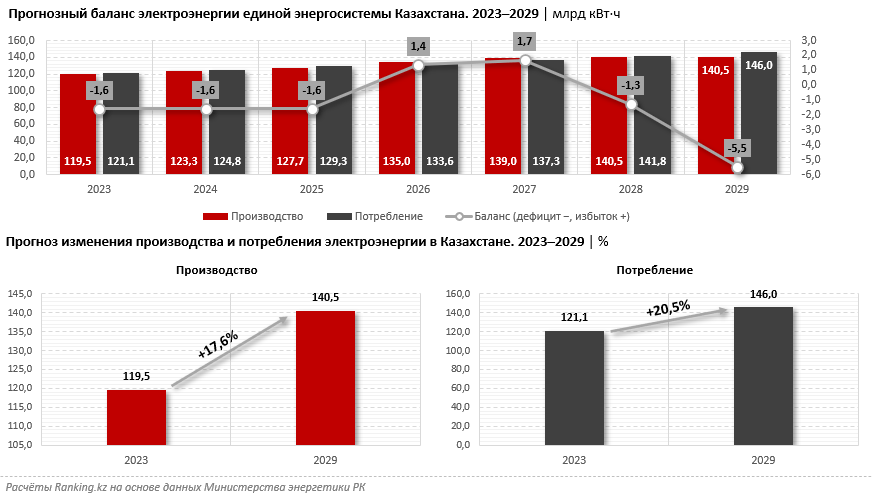
Production and demand forecasts.
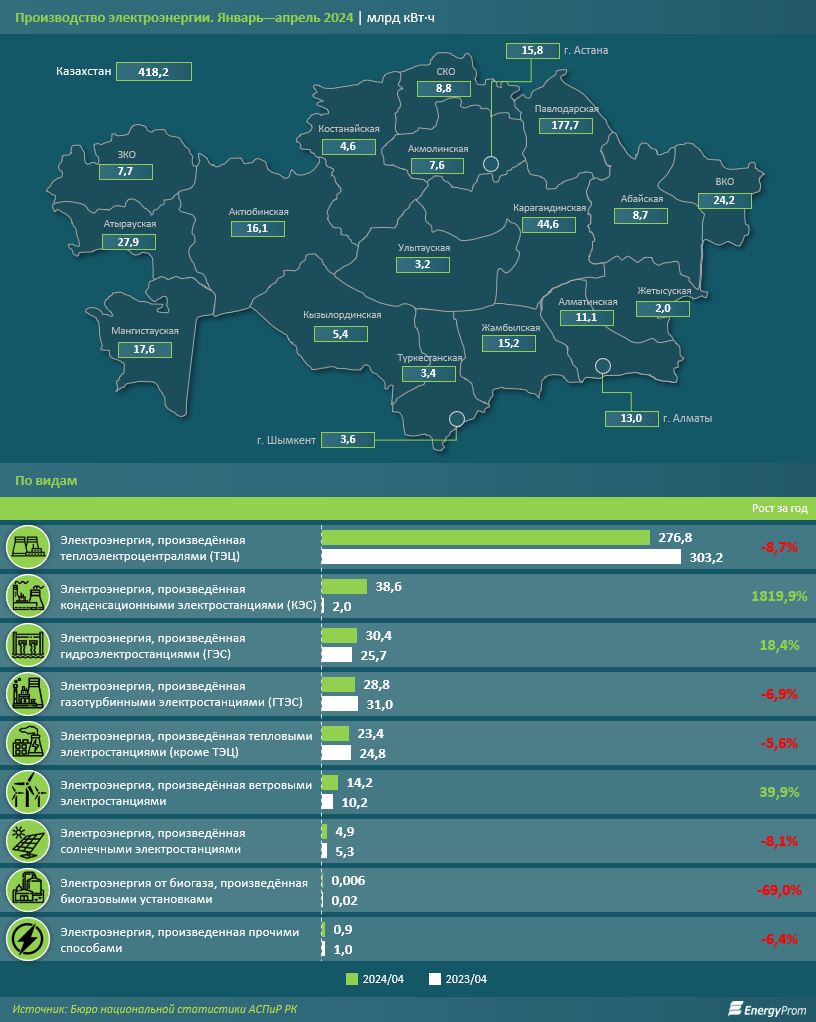
Share of each region of Kazakhstan in production. Share of each type of power plant
The first representative of the Ministry of Transport of Uzbekistan, M. Omarov, met with representatives of the European Commission delegation within the framework of the Trans-Caspian International Transport Corridor Coordination Platform. Uzbekistan is seeking a stronger transport infrastructure in the region, which could be helped by the construction of the Kyzylorda (Kazakhstan) – Uchkuduk (Uzbekistan) railway line.
The creation of a modern link between these cities would benefit the whole region in terms of integration and trade relations. However, the construction of the railway would also make a significant contribution to strengthening the idea of the Trans-Caspian International Transport Corridor. The latter is often mentioned when dealing with the current logistical situation in the region in relation to the interests of the European Union and exports from China.
Uzbekistan has applied to the European Bank for Reconstruction and Development and the European Investment Bank for funding for this project as part of the coordination platform. The project is being prepared jointly by the Ministries of Transport of Uzbekistan and Kazakhstan.
After the outbreak of the armed conflict in Ukraine, the issue of developing transport corridors that would not pass through Russian territory became more pressing than ever. In this regard, special attention is paid to the Middle Transport Corridor, which until recently was considered a weak alternative to roads through Russia. Will the new route be able to replace the traditional transport arteries connecting China and Europe?
From first plans to implementation
The Middle Trade and Transport Corridor or Trans-Caspian Transport Route is an infrastructure project through which goods can be delivered from China to Europe through the territories of Kazakhstan, Azerbaijan, Georgia and Turkey, that is, bypassing Russia. The idea of the project was first expressed in 2013, and the first practical steps to create the necessary infrastructure and remove trade barriers between the participating countries began in 2015.
Before the events of February 2022, many experts and politicians were quite skeptical about the idea of a transport corridor, emphasizing the existence of a number of problems, such as opaque pricing and logistical difficulties. But the lack of special interest in this route from China was especially emphasized: “In the absence of China’s geo-economic involvement, the development of the Middle Corridor still has little economic basis.”
Transport corridor in the context of Ukraine
The situation changed greatly after the start of the conflict in Ukraine: business immediately turned its attention to the Trans-Caspian transport corridor.
Thus, according to the International Association TITR, which unites shipping companies and ports, the volume of transportation along this corridor in 2022 increased by 86% and reached 2.8 million tons compared to 1.5 million in 2021 – then 586,000 tons were transported in 2021. According to the World Bank, in 2022 the volume of container traffic on this route increased by 33% compared to 2021
Political interest in expanding freight transport capabilities across Central Asia has also grown markedly: in November 2022, Azerbaijan, Georgia, Kazakhstan and Turkey signed a so-called road map that identifies priority areas for investments and activities needed to improve the Trans-Caucasus Transport Corridor (TCTC). In June 2023, Azerbaijan, Georgia and Kazakhstan agreed to create a single logistics operator.
The importance of the new route was also discussed in Brussels: European officials announced Europe’s intention to abandon the transit of goods through Russia, through which 86% of goods from China passed before the war.
The EU’s interest in the new transport route is expressed not only in words, but also in concrete steps. Thus, in January 2024, the Global Gateway Investors Forum for EU-Central Asia Transport Connectivity was held in Brussels, during which politicians and businessmen made a number of important statements directly related to this project. In particular, it was announced that the forum participants would invest $10 billion in the development of the region’s transport infrastructure.
In addition, the European Commission announced:
● the launch of the EU-funded Regional Transport Programme, which will be adopted in 2025 (Regional Transport Programme). Under this new programme, the EU will offer technical assistance to modernize and maintain transport routes.
● creation of a Coordination Platform to quickly solve current problems that require joint efforts of partners.
● the emergence of new positions in the Ministries of Transport of all five Central Asian countries from 2024, which will directly work on the implementation of the new transport corridor.
For its part, the European Investment Bank (EIB) signed memorandums of understanding totaling €1.47 billion with the governments of Kazakhstan, Kyrgyzstan and Uzbekistan, as well as the Development Bank of Kazakhstan. These loans will be possible thanks to guarantees provided by the European Commission.
Finally, the European Bank for Reconstruction and Development (EBRD) signed a memorandum of understanding with Kazakhstan, with an investment portfolio of €1.5 billion. These funds will be used to implement already selected projects.
Current issues
Despite the fact that in light of the armed conflict between Russia and Ukraine, the transport corridor began to be used more and more often, and European and regional politicians expressed full support for the project, many problems have not been resolved, as World Bank experts write about in a special report dated November 2023 .
“The capacity of the UK was not exhausted, however, problems with border crossing, transshipment and coordination led to very large delays in transportation and a subsequent return to alternative corridors. As a result, the volume of container traffic in 2023 (over 8 months) decreased by 37% compared to the same period in 2022,” the study emphasizes.
What worries business today:
● Cost of transportation. With reference to surveyed transportation participants, World Bank experts state that one of the main problems is the cost of transporting goods, which is comparable to the cost of transportation through Russia, although that route is much faster.
● Transportation time. In 2022, transporting goods from Dostyk or Khorgos to Constanta via the UK took an average of 50-53 days, which is twice the time required when transiting through Russia.
Why is this happening:
● Lack of a single operator who would be responsible for transporting cargo along the entire route. Currently, customers need to track their cargo on the websites of different country operators.
● The second limitation is related to the low operational efficiency of ports on the Caspian and Black Seas, as well as maritime transport in the Caspian Sea.
For example, some ports do not operate when the wind at sea is very strong, which immediately affects the speed of cargo delivery. For example, in September 2023, the president of the NC Aktau International Sea Trade Port, Abay Turikpenbaev, said that their mobile inspection complex cannot operate in strong gusts of wind.
● The third limiting factor is the lack of end-to-end rail infrastructure, which causes delays when cargo needs to be moved from rail to sea.
● Delays at border crossing points due to the lack of a single operator.
● Integration of document flow (each country has its own documents, forms, etc.).
Future prospects
According to World Bank analysts, the overall increase in trade turnover between China and the EU will increase by about 30% by 2030, and the volume of cargo transported along this route will increase 3 times. However, if measures to improve the operation of the Trans-Caspian Corridor are not implemented, then demand for transportation will be 35% lower than the projected increase.
At the same time, as World Bank experts predict, even with the successful implementation of all infrastructure projects, this route will play a more important role in regional rather than transcontinental trade: by 2030, trade between Europe and China will account for less than 40% of the volume of transported cargo.
In any case, in the context of deteriorating relations between Russia and Europe, the EU is extremely interested in expanding the capabilities of the Trans-Caspian corridor, so it will invest material, technical and political resources in this project.
At the beginning of 2023, Russia announced the construction of two new transport corridors from China towards Europe, bypassing Kazakhstan. The first is through Kyrgyzstan, Uzbekistan to Turkmenistan, and then through the Caspian Sea to Astrakhan (South transport corridor). The second is the continuation of the new Moscow-Kazan highway to Novosibirsk, and then through the Altai Republic or Mongolia to China. Experts also add to this list the North-South route through Azerbaijan (restoration of railway infrastructure. Russian investments are estimated at $1.3 billion). In recent months these projects have generated a wave of discussions about the allegedly growing tension in Russian-Kazakh relations.
South transport corridor – A memorandum on its formation and development of the southern transport corridor was signed in November 2023 by participants in the first SCO transport forum in Tashkent (Uzbekistan).
The first route is more the interest of Kyrgyzstan. Bishkek intends to create an opportunity to enter the Russian market, bypassing the territory of Kazakhstan. Among the reasons cited is the need to bypass queues at the Kazakh-Kyrgyz border. But it is obvious that it is not the point. Kyrgyz businesses are the transit of Chinese goods to the territory of the EAEU. And not so long ago, Kazakhstan detained a shipment of drones to Russia. Theoretically, there is no customs border between the EAEU countries and transport with drones should not have been stopped. However, the Kazakh side is in control of the situation. Kazakhstan is the only country in the region that has placed exports and re-exports to and from Russia under the control of American structures. It seems that in Kazakhstan the fear of secondary sanctions from the USA significantly outweighs its own interests, primarily economic ones. Kazakhstan’s position raises many questions about its fulfillment of its obligations within the EAEU and the CIS free trade zone.
The project of creating a route through Uzbekistan, Turkmenistan and further by sea has little economic feasibility, since goods will leave the EAEU zone and then cross the border again, which will obviously lead to higher prices for supplies. There is an opinion that the talks about the Southern transport corridor is aimed to put pressure on Kazakhstan to remove restrictions on the border for transit cargo. Real steps to implement this route will challenge Kazakhstan’s participation in the North-South corridor project. It connects Russia and India and passes through Azerbaijan, Iran, Kazakhstan, and Turkmenistan. Many experts note that the removal of restrictions on the Kazakh-Kyrgyz border and the Russian-Kazakh border on the part of Kazakhstan can at least slow down the implementation of this project.
In the transport corridors under consideration, problems on the border of Kyrgyzstan and Tajikistan fade into the background since interaction goes through Uzbekistan. On the other hand, we witnessed some major changes on their 972 km long common border. The work of the intergovernmental commission has continued since last year, and to date the parties have agreed on approximately 889 km of the state border out of 972 km. Even if the corridor is not supposed to lead across their border, it helps stability in the region and, theoretically, this could create an alternative to existing corridors or those under construction.
The implementation of these projects will be significantly influenced by Kazakhstan’s activity in attempts to comply with sanctions and the development of routes bypassing Russia. Now Russia is not very serious about Kazakhstan’s attempts to develop the Kazakhstan-Azerbaijan route, since its capacity is limited.
The transport industry of Kazakhstan provides about 9% of GDP, which is quite a large amount. According to the Ministry of Industry and Infrastructure Development of the Republic of Kazakhstan, 13 international transport corridors pass through the country. Among them, it is worth highlighting the Trans-Asian Railway (TAR), TRACECA and North-South, all of which in one way or another connect Asia with Europe.
As we know, there have been or are attempts to bypass Kazakhstan due to its control of border crossings. However, since Kazakhstan’s dependence on China is high, the likelihood of a deterioration in relations due to the construction of new corridors is low. Kazakhstan will remain a significant transit partner for China.
Generally, it is unlikely that the development of alternative transport projects will cause any serious political tension in the region. In bilateral relations between Russia and Kazakhstan or between Kazakhstan and other Central Asian countries, transport transit issues are significant but not the most important ones. In the context of geopolitical changes, when regionalization processes became more important than globalization, relations with neighboring countries will become more and more important.
Finally, we can add that a major change for Kazakhstan will be the successful construction of the railway China – Kyrgyzstan – Uzbekistan. Kazakhstan could probably suffer significant losses in the event of the combined implementation of projects on the southern transport corridor and the China-Kyrgyzstan-Uzbekistan railway. Until recently, these were hypothetical planes, but in the last days we come to know that the construction of the railway can begin as early as the end of 2024.